
Research
What can gravitational waves tell us about the spacetime they travel through?
My research centers on wave propagation in curved spacetime: how gravitational waves are generated near black holes, how intervening matter changes them on their journey across the Universe, and how we can extract that information from detector data. I combine black-hole perturbation theory, gravitational lensing, and statistical inference to connect the physics of the signal to what we can actually measure.
Two closely connected directions drive my work: using gravitational-wave lensing to probe otherwise inaccessible sources and matter, and understanding black-hole dynamics through the radiation that escapes to infinity and falls toward the horizon. Across both, I develop computational methods and open-source software that make new calculations and searches possible.
Gravitational-wave lensing
Reading the matter between us and the source
A gravitational wave carries information about more than the binary that produced it. Galaxies, clusters, and compact objects along its path can magnify it, produce multiple images arriving at different times, or distort it through interference and diffraction. These effects offer a way to study both distant sources and the intervening matter distribution.
I work on the connection between these physical signatures and practical searches. With Ignacio Magaña Hernandez, I developed a Bayesian framework for identifying strongly lensed signals that accounts for astrophysical populations and selection effects. This is implemented in hanabi, my analysis framework used within the LIGO–Virgo–KAGRA Collaboration. A central question is whether apparently similar signals are repeated images of one source or unrelated binaries that happen to look alike.
Highly magnified waves and diffraction
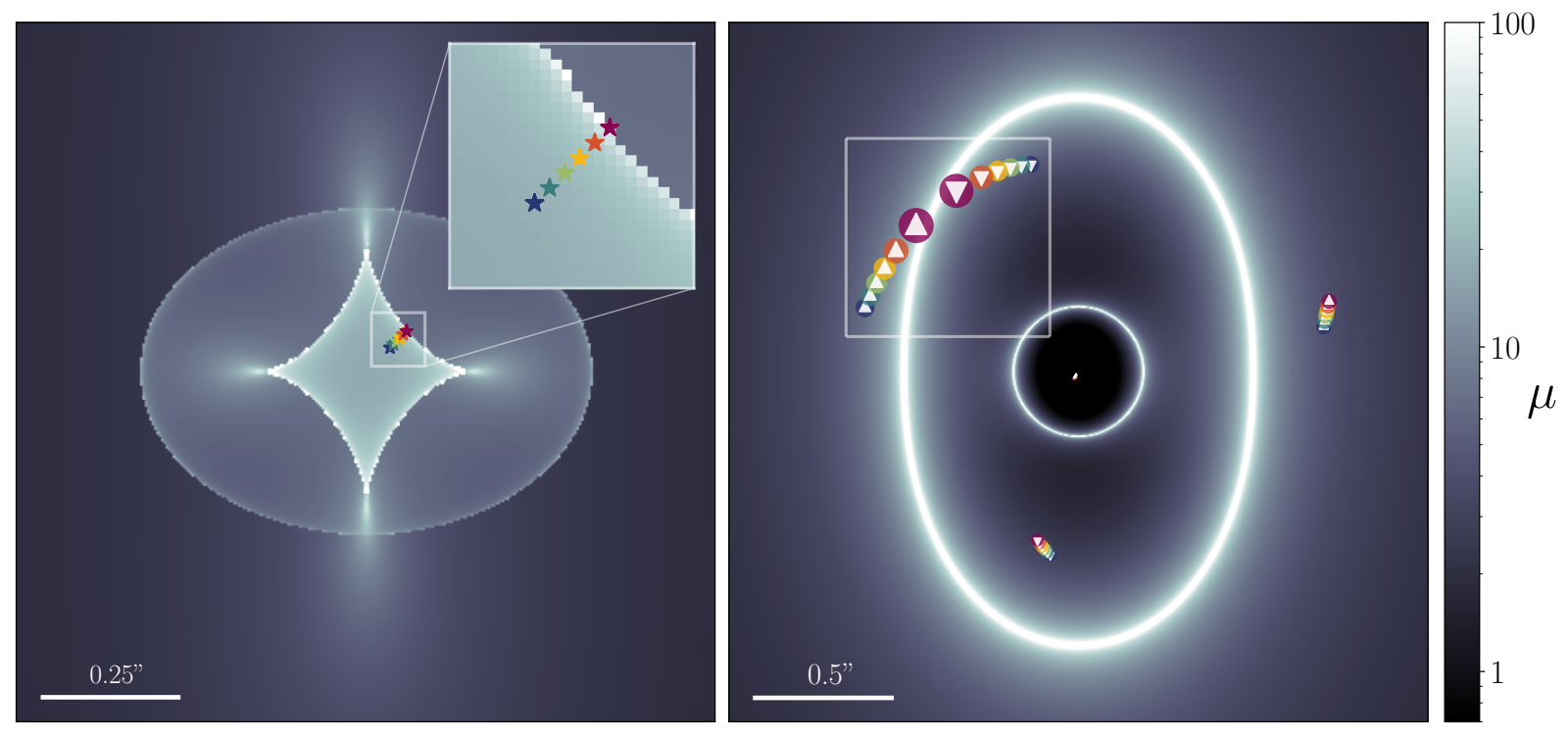
In our work on highly magnified gravitational waves, we showed how the geometry near a fold caustic produces distinctive signatures: closely spaced images can overlap and interfere, while diffraction limits the amplification and changes the waveform. Our subsequent study of diffraction around caustics explored point, fold, and cusp configurations, connecting their wave-optics behavior to observable distortions.
Finding these signatures requires both accurate models and enough simulations to establish their statistical significance. I co-developed DINGO-lensing, which uses neural posterior estimation to accelerate lensing inference. In our analysis of GW231123, this made an extensive simulation campaign possible. The study also illustrates why careful calibration matters: support for a lensing model did not establish a lensing detection, and waveform systematics affect the interpretation.
Looking ahead, I want to turn these methods into probes of dark-matter substructure, compact lenses, and cosmology. The challenge is to infer the source, lens, and population properties together while accounting for which signals our detectors can see.
Black-hole dynamics
From the outgoing waveform to the horizon response
When a black hole is perturbed, some gravitational radiation travels outward and some falls toward its horizon. These are two parts of the same physical response. I study how to calculate them accurately, and what their relationship can teach us about the dynamics of a black hole.
Much of my work uses the generalized Sasaki–Nakamura formalism, which recasts the equations for perturbations of a rotating Kerr black hole into a form suited to numerical calculation. I developed methods for computing homogeneous solutions, and with collaborators extended this approach to waveforms and fluxes at infinity from particle sources.
With Yucheng Yin, I constructed a nonsingular source term for near-horizon gravitational perturbations, overcoming a divergence problem in frequency-domain calculations. We used it to calculate the horizon’s response to a particle plunge and the energy flux toward a rotating black hole from an extreme-mass-ratio inspiral.
Ringdown and black-hole tomography
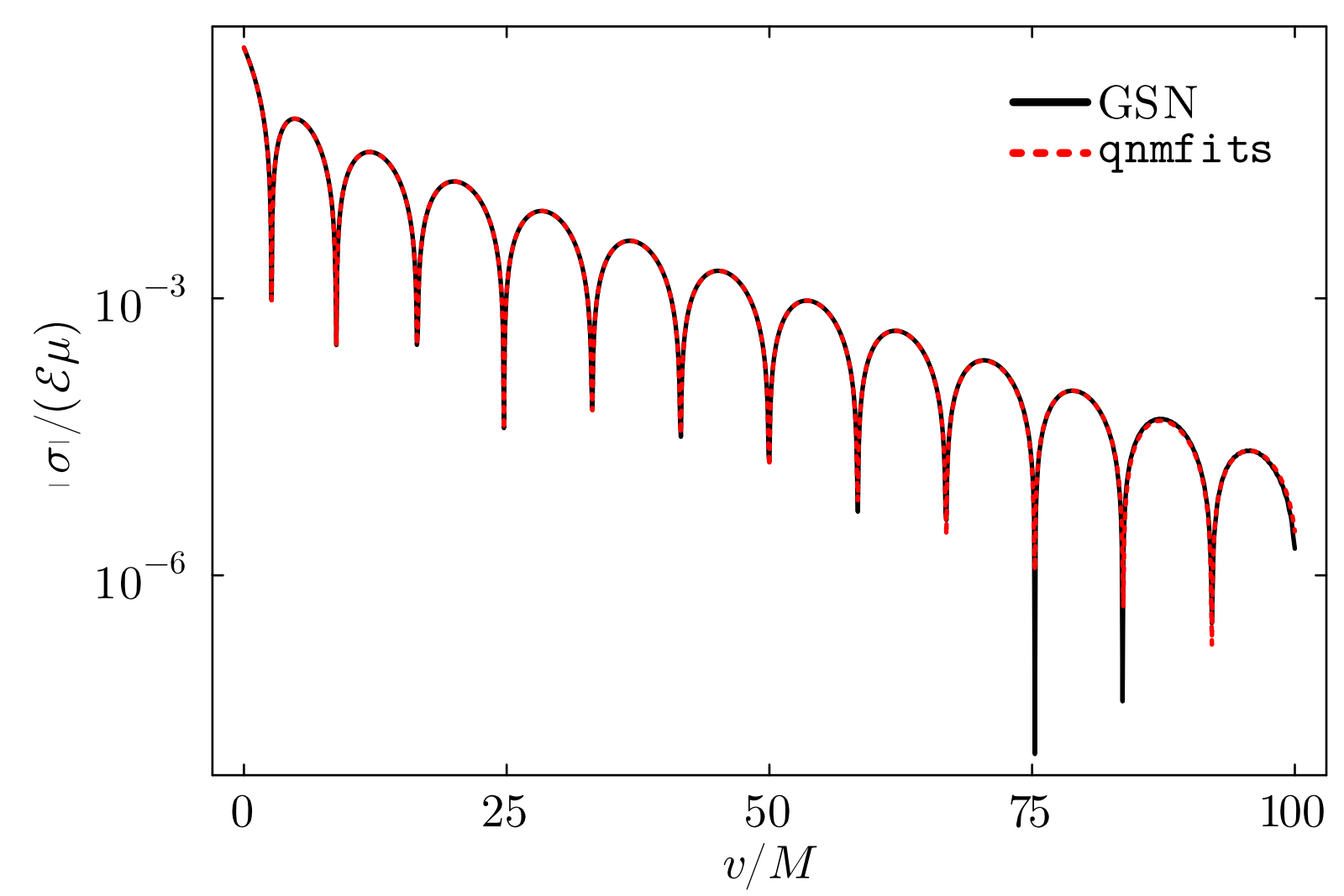
A perturbed black hole relaxes through characteristic damped oscillations called quasinormal modes. With Leart Sabani and Vitor Cardoso, I developed a method for computing their frequencies and excitation factors. These quantities help us understand the ringdown spectrum and the black hole’s contribution to the excitation of each mode. You can explore our results in the interactive QNM plots.
My longer-term goal is black-hole tomography: using gravitational waves measured far away to infer aspects of the horizon’s dynamical response. I am interested in building this connection for physically driven perturbations, including orbiting and plunging bodies, and determining which features can be reconstructed from observations. Extreme-mass-ratio inspirals observed by LISA are a particularly compelling setting for this program. The near-horizon calculations provide a foundation; establishing what can be inferred from realistic data is the next step.
Tests of gravity
Distinguishing new physics from familiar complications
I also work on ways to test whether compact objects and their radiation behave as general relativity predicts. My earlier research developed a Bayesian search for gravitational-wave echoes, hypothetical late-time signals associated with some models of exotic compact objects. Applying that method to Advanced LIGO’s first observing run yielded no statistically significant evidence for echoes.
Related collaborative work includes numerical echo waveforms for spinning exotic compact objects, searches for alternative gravitational-wave polarizations, and the effects of detector glitches on tests of general relativity. These projects share a practical question with my lensing research: how do we distinguish a physical departure from our standard model from noise or an imperfect waveform?
Software and data
I make the methods behind my research available as reusable tools. A few starting points are:
- hanabi — joint and hierarchical Bayesian analyses of potentially lensed gravitational-wave signals.
- DINGO-lensing — simulation-based inference for distorted gravitational waves, developed with collaborators.
- GeneralizedSasakiNakamura.jl — numerical solutions for perturbations of Kerr black holes.
- lenscat — our public, community-contributed catalog of known strong gravitational lenses.
See Tools for more software, Data for research outputs, and Publications for the full publication list. I welcome conversations about gravitational-wave lensing, black-hole perturbation theory, and the statistical methods that connect them to observations.